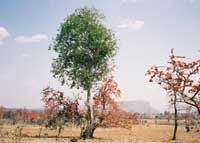
I was told as a geology student in the 1960s, over 50 years ago, that Gondwana meant land of the Gonds, and that they were a tribal people living somewhere in India. The idea of going there one day stayed in my mind over all the years and many travels. It was this that I set out to find in early 2007. I started with my Times atlas, searches in library catalogues and on the web, and discovered my destination lay in the state of Madya Pradesh. Gondwana: the wordGondwana: "land of the Gonds". The origin of the word is hazy, but Indian historians seem to agree it was first used by Afghan traders who came into Gond territory in central India around the 11th or 12th centuries. But the Telugan people of Andra Pradesh also may well have coined the word or used it. The Telugu-English Dictonary tells us konda is hill or mountain; kondajaati, a hilltribe, goondu the name of a hilltribe, and wana a wood, forest or grove. "Gond" (also spelt "Goond") is also possibly a corruption of "Khond" or "Kond", the name of one of the tribal groups comprising the "Gonds".Gondwana: the placeIt refers to an area covering the north Godavari and Narmada River valleys, occupying most of Madya Pradesh, meaning Central Province, a state of India created from a group of old states after independence. However Gond people are spread over a wide area of central, and central eastern India covering seven states.Key locations
Narmada River: the major river flowing through Gondwana. Also the only major Indian river that flows east-west, to the Arabian Sea; to the north all join the Ganges flowing east to the Bay of Bengal; to the south the Godivari and others also flow east. Amarkantak is the source of the Narmada River, on the eastern spurs of the Maikal Hills, part of the Satpura Range; it is sacred and an annual festival is held there. (The peak is a thick Deccan Trap; see below about the geology.)
Satpura Range: a composite feature created by British mapping; includes the Mahadeo Hills, Maikal Hills and others spread across the Gond heartland.
Bhopal, Bhimbetka and Raisen: one of the world's most important rock art precints; the approximate northern limit of Gond territory. Bhimbetka: Acheulian (Lower Palaeolithic or earliest stone age), Middle and Upper Palaeolithic; then Mesolithic. Rock paintings in three phases from Upper Palaeolithic, Mesolithic and later historic periods. Gondwana: the peopleThe Gonds are a large heterogeneous group of tribal people, numbering in the millions. They are regarded as the aboriginal people of the Gondwana area (although another people called the Baiga are also aboriginal in certain areas of central-eastern Madya Pradesh). They are given an official status as such under an administrative scheme called the Scheduled Tribes of India, which was set up around the 1950s after independence.By heterogeneous we mean the groups vary a great deal in social and cultural aspects, and in their history. There is a Gond language - Gondi - one of the central-southern Dravidian family of languages, which includes Tamil and Telugu. However only a limited number of Gond groups speak Gondi. What makes someone a Gond seems to be a loose assortment of cultural factors - religious beliefs for example. There is a Gond myth of the creation of the world and the origin of the Gonds, involving a divine hero called Lingo, sometimes called the Moses of the Gonds.
Gonds like to sit around the fire and sing at night. They have been noted for excessive drinking, making them uncompetitive with the Hindus, drinking spirit distilled from flowers of the mahua tree, and in the south, fermented date-palm juice. Historically, some Gonds were also urban dwellers of fortified feudal city states. Some practiced human sacrifice, to the goddess Kali. This lasted until 1853 in the city of Nagpur, but in the mid-nineteenth century they made a point of giving it up because of public opinion. Rajput GondsDuring the European Middle Ages, Rajput Hindu people pushed down from the north into Gond territory. It was under their influence that a number of Gond groups developed feudal kingdoms, for example at Mandla, Betul and Chhindwara. Feudalism contributed to the process of detribalization.Rani DurgavatiFamously, in the 1560s, there was a Gond queen at Mandla, who was of Rajput stock. Her name was Rani Durgavati and she was and still is a popular figure amongst the Gonds. By this time the Mughals had invaded northern India and were also pushing south into Gond territory. The Rajputs and Gonds formed alliances against the Mughals. Rani was a famous beauty and the wicked Asaf Khan, the Imperial Viceroy in Delhi, lusted after her and her kingdom at Mandla. She was recorded as having 1400 elephants. In 1564 Asaf laid siege to Mandla. When Rani realised she could not win the fight she committed suicide by stabbing herself. Her son, inheriting her crown, was forced to move his seat of power further south to Golkonda. Various other defeats of the Gond states followed, the last Gond king dying in 1790.
Arrival of the BritishThat brings us to the eve of the arrival of the British. "British" then meant the East India Company (EIC), which had been given sole rights to trade in India by Queen Elizabeth I in about 1600. They had been spreading slowly across India ever since, the major growth of the areas under their influence being in the 18th century. By the early 19th century the Hindu rulers of the northeast of India were in their final struggles against the British, who then had effective control over most of India. But their movement into Gondwana was quite slow at first.In 1795 a Captain Blunt undertook an expedition from Varanesi (formerly Benares) to the north of Gondwana, right down through it to Rajamundry in the south. With the probable exception of Ptolemy, his observations of the nudity of the Gonds appear to have kicked off the ethnographic record. Generally their reputation in these times was as naked savages living on roots and fruits and hunting strangers for sacrifice, and fiercely independent. In 1820 a Lieutenant Prendergast noted that the Gonds were cannibals that ate their own relatives. There was an expedition into Central India led by a Sir John Malcolm in the 1830s, which seems to have been the first to report on the geology and archaeology of the area. We will return to that shortly. Written accounts of Gonds remained rare. Eventually missionaries and scientists followed the spread of empire and were often the first ethnographers. For Gondwana the first serious ethnography was undertaken by a missionary, the Rev. Stephen Hislop, probably in the 1850s. He was the first to record the legend of Lingo but he didn't publish during his lifetime. Some journal articles about the Gonds began to be published: The Journal of the Bombay Branch of the Royal Asiatic Society 1853 includes an item about "the Gondwana highlands and jungles [comprising] a large tract of unexplored country". It states: "Captain Blunt's interesting journeys in 1795 give almost all the information we possess...such a description would scarcely be applicable anywhere out of Central Africa". By the 1850s Gondwana was still one of those dark mysterious blanks in the map of the empire. Siege of Lucknow, 1857
The British penetration of Gond lands then stepped up. This resulted in more about the Gonds being published. In 1860 there was an article in the EIC Gazetteer describing "Gondwana, the land of the Gond race", and Hislop's findings were published post-mortem in Papers on the Aboriginal Tribes of the Central Provinces 1866. The significant activity in the history of Gondwana is that it was during these years that the British geologists first came into the area. They were primarily looking for coal, which had already been found by the EIC at Hoshangabad on the edge of the Gond lands near the Narmada River, where they opened the first coalfield in 1852. Captain James Forsyth
Gondwana: geologyCharles Lyell, in the first edition of Principles of Geology in the early 1830s, refers to a recent expedition into Central India by one Sir John Malcolm. From the information in Lyell's book, this would have been into the area below the Mahadeo Hills and downstream from Hoshangabad. A member of the expedition, the well-named Captain Dangerfield, reported on the geology of the Narmada (Nerbuddah) River channel, and some archaeological finds regarding cities buried by volcanic activity in the area. But Lyell does not mention Gondwana (or Glossopteris; see below); the final edition of the Principles was the 12th of 1875, still without mention of Gondwana.The history of the geology of Gondwana does take off in a sort of logical progression from the ethnographic history. The Geological Survey of India (GSI), an arm of the British administration, is the organization that mattered. One of the main things exercising their minds was the search for coal resources, already found and mined by the EIC. They knew about Glossopteris, which is the main plant fossil found in the Permian coal deposits that came to be recognized as a major feature of Gondwanan remnant landmasses (the taxon was established by 1830). GSI geologists worked along the Narmada River and up into the Satpura Range. Early workers in the field were:
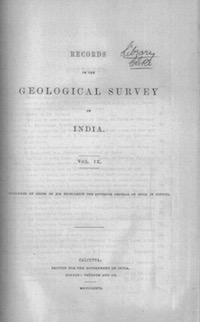
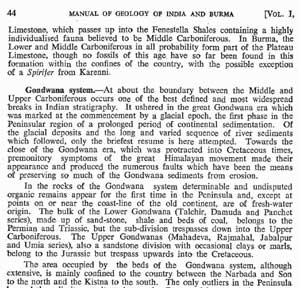
It was soon revealed that there were a number of geological basins throughout the whole area of central India with the same sequence. The crucial early example was those having formed in the Satpura Basin and later pushed up to form the Satpura Range. H.B. Medlicott mapped these (although the Satpura name wasn't given until 1893 by his colleague's son R. D. Oldham). The two Medlicotts were brothers, as were two Blanfords; they would have been part of a small colonial community. The Blanfords published works on geology, mammals and birds, molluscs and meteorology, from at least 1858. It doesn't take too much imagination to think they all would have read the sort of journal articles described above, and most likely would have stayed at James Forsyth's Lodge when they were in the area, and later read his book. The name Gondwana, one way or another, would have been well known to these geologists of the 1860s and early 1870s. Adoption of the nameThe important point here is that H.B. - Henry Benedict - Medlicott is credited with first naming this sequence the Gondwana series. He did this in unpublished reports for the GSI in 1872. The name was then adopted by other workers. The first credited with using it in print was Ottokar Feistmantel in 1876 (in spite of the name he was British, or at least worked for the GSI), in a paper in the Records of the GSI: Notes on the age of some fossils of India. In his preamble Feistmantel says: "...almost the only fossiliferous, rock series in the peninsular area of India, is that usually spoken of collectively as the plant-bearing series. This is an awkward designation; I will at once adopt instead the name GONDWANA series or system, to be understood in the same wide sense as when we speak of the Jurassic or Silurian series or system. The name was proposed some years ago by Mr. Medlicott, and has since been more or less current on the survey; it has been once used in print by Mr. H.F. Blanford in his little work on the Physical Geology of India".
The latter work has either sunk without a trace, or Feistmantel has almost certainly confused it with a work listed in the British Library catalogue: H. F. (Henry Francis) Blanford The Rudiments of Physical Geography for the use of Indian Schools 1873 (1874 and 1878). The Oxford Dictionary in fact names this as its first published use of the word, quite ignoring Forsyth's 1871 book and the other earlier sources. But for geology at least Feistmantel gets first naming honors. (This paper also discusses Glossopteris. He later continued this work, and published, in Australia.)
Eduard Suess adds the "-land"An important example was Eduard Suess, Professor of Geology in the University of Vienna, who published a landmark book: Das Antlitz der Erde 1885. This book collated the then known geology of the earth, and referred to Medlicott and Blanford's book for the geology of India. It was translated into English in the early 1900s as The Face of the Earth. It seems - at least according to the Oxford Dictionary - that it was Suess who started using the term "Gondwanaland", and that W.T. Blanford (1896) was the first to do so in English, and he specifically refers to Suess as his source. It looks like they tacked the '-land' on to distinguish the supercontinent from the original Gondwana territory, which possibly gives it a certain validity inspite of the tautology.Alfred Wegener and continental driftThe similarities of the southern continents, the Permian non-marine sediments, the Glossopteris flora and so forth, had made the idea of a supercontinent of "Gondwanaland" well-known by the time Alfred Wegener proposed his theory of continental drift in 1912; he refers to works as early as 1857 amongst the vast literature that he had read. Wegener was an interesting character, an intellectual rebel who looked outside the box. He was not a geologist, but a trained astronomer who mainly worked as a meteorologist until his untimely death on an expedition on 1930. He published the first edition of his book The Origin of Continents and Oceans in 1915. (Suess was just one of numerous references, and he wrote from a standpoint of the continuous contraction of the earth, a theory Wegener was seeking to refute.) In fact explaining Gondwana was a significant part of the intellectual challenge to come up with an acceptable theory of the earth's geological history. There was a lot of talk about land bridges and sunken continents which created more problems than they solved. Speculation on the 'fit' between South America and Africa goes back to Francis Bacon in 1620. The debate on drift theory raged for decades. While growing numbers of geologists and biogeographers tended to support it, it was a theory with a serious lack of explanation; the geophysicists were the last to accept it. Harking back to my years at Melbourne University in the 1960s, debate was still going. Some time in the mid-1960s Owen Singleton gave a lecture putting forward the stratigraphic objections, focusing on the South America - West Africa match up which was supposedly one of the strong arguments in support. From a geophysical point of view, we were taught that continental drift was akin to having a ship of butter ploughing through a sea of concrete; it just didn't make sense. Eventually palaeomagnetism proved it must have happened and plate tectonics solved the mechanical problem. The debate was won by the continental drift proponents but arguments have continued about various anomalies ever since with people like Sam Carey of "expanding earth" fame, Mac Dickins, a former ANU geologist and an uncle of mine, and Neil Archbold, a recent president of The Royal Society of Victoria, amongst those raising various questions. These debates were aired at a series of nine international Gondwana symposia held from 1967 to 1994, started by the International Union of Geological Sciences (IUGS) and taken up by various host organizations every few years, in Buenos Aires, Cape Town, Canberra (ANU 1973), Calcutta, Wellington, Ohio, Sao Paulo, Hobart and Hyderabad. The proceedings from each of these symposia are available in various libraries. According to Mary White (in her book The Greening of Gondwana 1986) the fifth of them, held in Wellington, New Zealand officially dropped the "-land" from the name, as it is a tautology. I can't find any confirmation of this in the proceedings for that fifth symposium, but it was absent in the proceedings of the sixth symposium. There have been many symposia since the 1960s. There was a conference on the flora of Gondwana in the 1960s, and a web search will bring up further conferences in recent years. Gondwana and popular cultureIn the meantime Gondwana or Gondwanaland has passed into popular culture. It seems to have acquired some particularly Australian cultural associations, with aborigines and Australiana. It has become a land of the imagination, an imagined space. There have been various books, some in popular science:
A more recent publication: V. A. Gostin (Editor) Gondwana to Greenhouse: Australian Environmental Geoscience 2001. Geological Society of Australia Special Publication 21. See The Study Interview with Vic & Olga Gostin. There have been bands and other music groups: Gondwanaland, a choir Gondwana Voices, and some totally over the top books like Craig Robertson's Song of Gondwana. Note: These notes and accompanying images are from a talk presented to the Victorian Ornithological Research Group (VORG), March, 2008. Gondwana References: these are the key works for the origin of 'Gondwana' and 'Gondwanaland' (although I think Forsyth's book would have established the term more than papers such as Erskine's). Perry, Honorable Sir Erskine, 1853. On the Geographical Distribution of the principal Languages of India, and the feasibility of introducing English as a Lingua Franca. Journal of the Bombay Branch of the Royal Asiatic Society, January 1853: 289-317. (See pages 301-302. This paper was submitted in July, 1852, and Erskine uses the term familiarly, as though it is already accepted. Prior issues of this journal and possibly others may well place the first published use of 'Gondwana' back at least to the late 1840s.) Forsyth, Captain James. 1871. The Highlands of Central India. Chapman & Hall, London. (See page 7 and elsewhere.) Blanford, Henry Francis, 1873. The Rudiments of Physical Geography for the use of Indian Schools. Calcutta: Thacker, Spink & Co. Feistmantel, Ottokar, 1876. Notes on the age of some fossils of India. Records of the Geological Survey of India, Vol. IX Part 2: 28-42. (See page 28; this is the first published use in geological literature). Suess, Eduard, 1885/1904. Das Antlitz der Erde/The Face of the Earth. Oxford: at the Clarendon Press. Blanford, William Thomas, 1896. On the papers by Dr. Kossmat and Dr. Kurtz, and on the ancient Geography of "Gondwana-land". Records of the Geological Survey of India, Vol. XXIX Part 2: 52-59. (Note that Suess established the term 'Gondwanaland' in his original German publication of 1885. W.T. Blanford appears to have first used it in English in this paper; on p. 52 he refers to Suess' usage. The two Blanfords were brothers.) Note 1: Both H.F. Blanford and Feistmantel refer to the term Gondwana being proposed by 'Mr. Medlicott', ie Henry Benedict Medlicott, in unpublished reports of the GSI. Blanford simply states that the term was proposed. Feistmantel states that he will actually use the term for the relevant geological formations and thus has first naming credit in geology, but not ethnography. Gondwanaland is a geological concept. Note 2: In my original lecture notes and web page I had included the statement: "In 1831 there had been a report by one William Henry Sleeman of a feral boy found with a pack of jungle dogs or wolves in the forest near Seoni." This came from the Lonely Planet 2005 guide I had used travelling through the area in 2007. I have researched this again and can find no record of a wolf-boy around Seoni, and note the latest LP guide has removed the box about wolf-boys and Kipling, and makes no mention of Seoni. The three sources quoted in the 2005 guide did not include the one that does deal with the subject of wolf-boys: Journey through the Kingdom of Oude; in 1849-1850 by William Henry Sleeman. It was published in 1858 in two volumes; Volume 1 recounts half a dozen cases of wolf-boys. They are all in the Oude region, which is in northern India, far from Seoni. Sleeman was well-known to the British public for his ruthless supression of the murderous Thuggee religious sect in the 1830s. He did some pioneering palaeontology in Madhya Pradesh, finding dinosaurs but not the Gondwanan flora, and there is no indication he went south of the Narmada River as far as Seoni. In the 1840s he moved north, to Gwalior and Lucknow. The pages of the journey describing the wolf-boys (202 to 222) were originally printed anonymously by Sleeman in a pamphlet in 1852: An Account of Wolves Nurturing Children in Their Dens, by an Indian Official. He was keeping a low profile because he opposed the British annexation of Oude, which was to be a leading cause of the Sepoy rebellion. (The paper was republished, again unattributed, in a journal The Zoologist where one of the cases is attested to by an eye-witness (Vol. 12, 1888, 87-98, 221).) We can safely assume Kipling knew of the Sleeman accounts by the 1890s when he wrote The Jungle Book. (There have been other reported cases of wolf-children of both sexes, famously two Indian girls in the 1920s, and children of other animals such and bears and sheep; see Robert M. Zingg: The Feral Man and Extreme Cases of Isolation, The American Journal of Psychology, Vol. 53(4), October, 1940: 487-517. Zingg lists 31 cases of feral children from the 17th to 20th centuries that he regarded as reasonably well-attested, but none are from Gondwana.) Update, December, 2016. After some more research I have now traced the use of the word Gondwana, as an ethno-geographic entity, back to 1803, in publications drawing on material from the 1790s. As the word originated from Muslim sources at the time of the European Middle Ages, the challenge is to find its introduction to the English language, which was probably some time in the 18th century. I intend to pursue this further and to write an account of my research for publication. Watch this space! Update, February, 2017. My research is now firmly back into the eighteenth century. The crossover to English usage remains hazy, and may lie in unpublished sources beyond my reach. Update, June, 2017. I now have a comprehensive account of how Gondwana was eventually recognized by the British, as a territory appearing on early maps, and of how the word entered the English language and was eventually picked up by the geologists in the 1870s. I am now considering how to publish this material, which is considerable in scope and draws on the lives of numerous remarkable characters and historic events. Update, 14 April, 2020. I have now a comprehensive account of the story of Gondwana as it came into the English language, Western geology and world-wide recognition as a supercontinent. It leads to some interesting speculation on its cultural impact. Update, 4 November, 2020. The notes above are showing their age and need revising in some sections, but I am still working on this project. One point that should have been corrected earlier: Stephen Hislop was the first European to make a substantial ethnographic study of the Gond people; he refuted the claims of cannibalism made by Prendergast, which were no doubt based on hearsay. This vexed issue so often seems to invoke an overactive imagination on one hand, or a wishful denial on the other. Update, 14 November, 2020. I have now also pushed the appearance of Gondwana in English (of a sort) back to the early seventeenth century; it's a refinement but doesn't significantly change the account as it stood last April (all a lockdown artefact!). Images from publications by Forsyth, Elwin, Geological Survey of India (Feistmantel), Medlicott & Blanford are all out of copyright. Otherwise photographs, recording and text © Copyright Craig Robertson, 2008, 2016-2020. Information on this page may be accessed and read for personal use. The material may not be copied or communicated to other parties without permission. |