 |
Buckley's Hope
a novel by
Craig Robertson
Scribe Publications, Melbourne 1980 - 2013
Cover design: Miriam Rosenbloom
|
On Boxing Day in 1803 a young English convict named William Buckley
escaped from Victoria's first settlement at Sorrento. Soon after, the
settlement was abandoned and Buckley was left behind. For thirty-two
years he survived in the wilderness,
mainly because he was adopted by local Aboriginal tribes.
In 1835 Buckley emerged with his tribal friends to meet Melbourne's
founders, and quickly became an important guide and interpreter in the
crucial first years of the European conquest of the Port Phillip region.
Trapped in the rapidly ensuing conflict between two vastly different
societies, Buckley found himself mistrusted by his former black friends
and by his white compatriots. He was so harshly reviled by the colonisers
that his reputation has suffered to this day.
Based on meticulous research, Buckley's Hope recreates
the fateful encounter between Australia's 'wild white man' and the original
inhabitants of the continent. Through Buckley's eyes we see how much
was at stake and how much was lost when two worlds collided.
Buckley's Hope was originally published in 1980 and has
remained in print for over 20 years. It was re-issued in 1997 with a
Foreword by Wurundjeri elder Joy Murphy and a new Preface by the author.
Now, as Australia struggles toward reconciliation between the two worlds,
Buckley's Hope has again been re-issued in 2002. The story
of William Buckley continues to haunt and challenge us all.
Reviews
"Prickles with authenticity...solidly blocks in the mythic quality
of the story...an Australian classic." Barry Hill, The Age
"Robertson has told his story sensitively." Peter Pierce, Sydney
Morning Herald
"Craig Robertson has done it proud." Peter Corris, National Times
 |
In November 2006 a slightly belated party was held in the bar of the Melbourne Trades Hall, Lygon Street, Carlton, to celebrate the 25th anniversary of the publication of Buckley's Hope and its continual record in print for that period. I spoke briefly about writing the story, then and now. Henry Rosenbloom spoke about publishing, then and now.
Barry Hill spoke about the influence of the book, and then read three of his poems from his book Ghosting William Buckley (William Heinemann Australia, Melbourne, 1993). This was followed by Jan Wositzky performing extracts from his show about William Buckley, and Gregory Day and Julitha performing songs of their own about the man. An enjoyable afternoon for all.
(Left) Craig and Jan take the man for a ride. |

At the party: myself, Henry Rosenbloom and Barry Hill speaking (photos: Peter Robertson); Jan Wositzky performing (photo: Stef Wallace)
 |
The Friends of William Buckley, based at St. Leonards on the Bellarine Peninsula, Victoria, celebrated the 200th anniversary of William Buckley's escape from Sorrento with a series of cultural events and publications over 2003 to 2005.
(Left) Unveiling the man at the FoWB official launch, 2 January, 2004.
|
Readings: Craig Robertson reads excerpts from Buckley's
Hope (Note: These files are on The Expedition CD, where there are also some photos of the country.)
|
How to order
You can purchase directly from the Scribe website.
Note the links to buy the ebook from Amazon Kindle or Kobo.
Buckley's Hope is also available from all good bookshops; have yours order
one if not in stock.
Mail order from the author is not available.
Publishing History

|
2014 UK reprint
Cover design (UK only): Miriam Rosenbloom; includes:
Buckley's Escape by Tommy McRae, c. 1890.
Photo © Jason McCarthy, National Museum of Australia.
|
 |
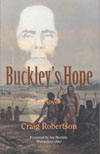
2002 Paperback Reprint
Cover design and illustration: Miriam Rosenbloom
|
 |
1997 Paperback Reprint with:
- new Foreword by Joy Murphy, Wurundjeri elder
- new Preface by the author.
Cover design: Andrew Cunningham
Montage of detail from Woodhouse painting and portrait of
William Buckley by unknown artist, both c. 1861 from the La Trobe
picture collection at the State Library
of Victoria
|
 |
1981 Paperback
Cover illustration: F. Woodhouse c. 1861
First settlers discovered Buckley (detail)
Reproduced by permission of the La Trobe Collection State Library
of Victoria |
 |
1980 Hardback
Cover illustration: F. Woodhouse c. 1861
First settlers discovered Buckley
Reproduced by permission of the La Trobe Collection State Library of Victoria. |
|
Text, photos and audiovisuals © Copyright Craig Robertson, 2007-2021, except where otherwise attributed.
Information on this page may be accessed and read for personal use. The material may not be copied or communicated to other parties without permission. |


